
In our preparations for the Semiquincentennial, the Gerald R. Ford Presidential Library & Museum is reflecting on the Bicentennial in 1976, for perspective on the upcoming celebrations. What we’ve found is that while planning for the events had begun during the post-war optimism of the 1950s, by the 1970s many Americans were also worried that there was a lack of national excitement for the Bicentennial.
The country had faced the assassinations of multiple political leaders, the quagmire of war in Vietnam, the resignation of both the Vice President and President amidst unprecedented political scandals, and near-crippling inflation and unemployment. Nevertheless, nationwide celebrations began in 1975 as the American Freedom Train began a cross-country Bicentennial tour on April 1. On April 19, President Ford visited Lexington, Massachusetts to mark where the first shots of the Revolutionary War had been fired.
In his speech, Ford said, “We have inherited a great tradition, but it is our job—older and younger people joining together—to see to it that when our ancestors meet here 100 years from now, they can say that what was done here on this date was the kick-off for a new century of unity, and progress, at home as well as abroad.” This speech set the tone for what Ford—and the American Revolution Bicentennial Administration—hoped to accomplish when celebrating the nation’s 200th birthday: using the past as an occasion to look forward to the future, and to do even better in the next 50, 100, and 200 years.
In the preceding decades of planning, first with the American Revolution Bicentennial Commission (ARBC) and then with the American Revolution Bicentennial Administration (ARBA), officials had determined that Bicentennial celebrations would be spread out across the country, with state, local, and private organizations planning event in each region. The idea was that this decentralized celebration would allow for greater citizen engagement. One demonstration of this multifaceted citizen participation is illustrated by the varied gifts that arrived at the White House.
While the White House Gift Unit had tracked and sorted presidential gifts since the Eisenhower administration, during the Bicentennial, the President and First Family received so many gifts directly related to the national celebrations that a new organization, the Bicentennial Gift Unit, had to be created to process them all. At the end of President Ford’s term in office, these gifts were transferred to the Gerald R. Ford Presidential Library & Museum. Now, out of the nearly 20,000 artifacts in the Museum’s collection, over 3,000 are Bicentennial items. These range from priceless jewelry and Revolutionary-era artifacts to handmade objects and folk art. This collection beautifully illustrates the many different ways people from all walks of life understood and commemorated the Bicentennial.
For example, heads of state from around the world gifted items to commemorate the Bicentennial. In May 1976, President and Mrs. Giscard d’Estaing of France visited the United States in recognition of the history of friendship between the two countries. As a gift to the U.S., President d’Estaing presented a printing press thought to have been used by Benjamin Franklin during his time as a diplomat in France. Two months later, in July 1976, Queen Elizabeth II and Prince Philip of Great Britain toured Philadelphia, the District of Columbia, Virginia, New York, Connecticut, and Massachusetts. Their visit culminated in a State Dinner held at the White House. On behalf of the British people, the Queen gifted to the United States the Bicentennial Bell, a replica of the Liberty Bell that hangs at Independence Hall in Philadelphia.
However, some of the most evocative and memorable artifacts in the collection are handcrafted items gifted to President Ford by ordinary American citizens. Some of these artifacts are precious and priceless, such as a white gold necklace made by a European American jewelry designer. The chain features thirteen diamond stars set in platinum, representing the original thirteen colonies. The pendant is in the design of the Bicentennial seal and features diamonds, rubies, and sapphires.
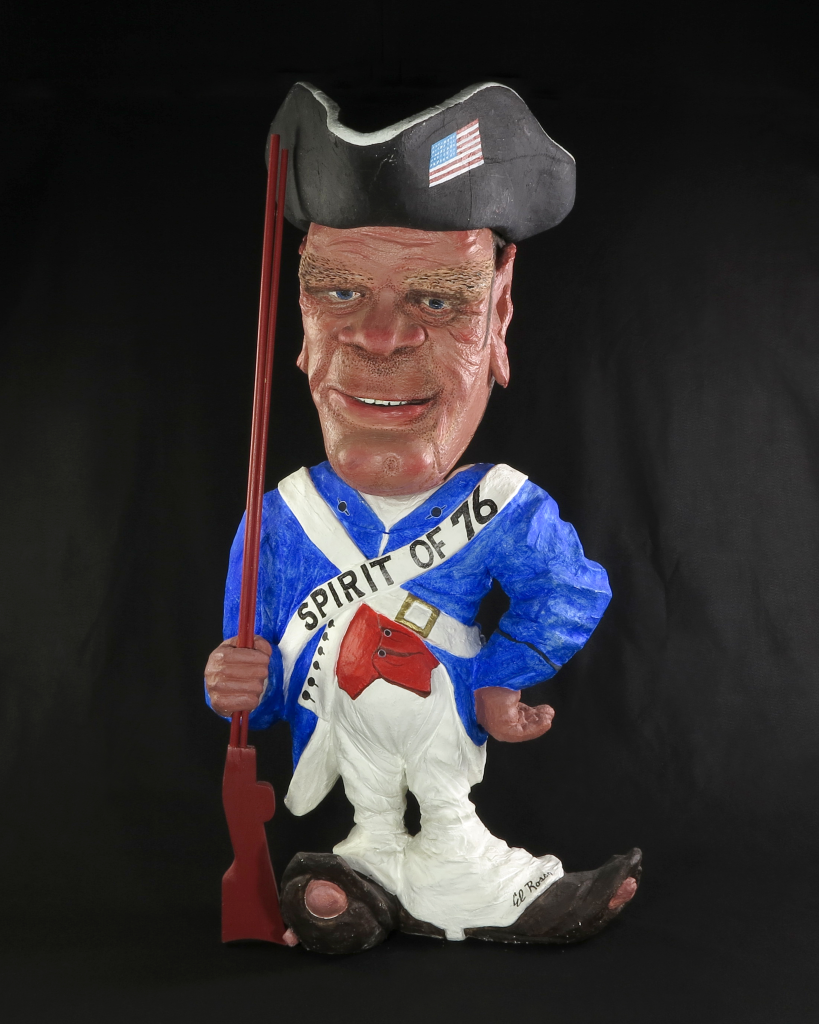
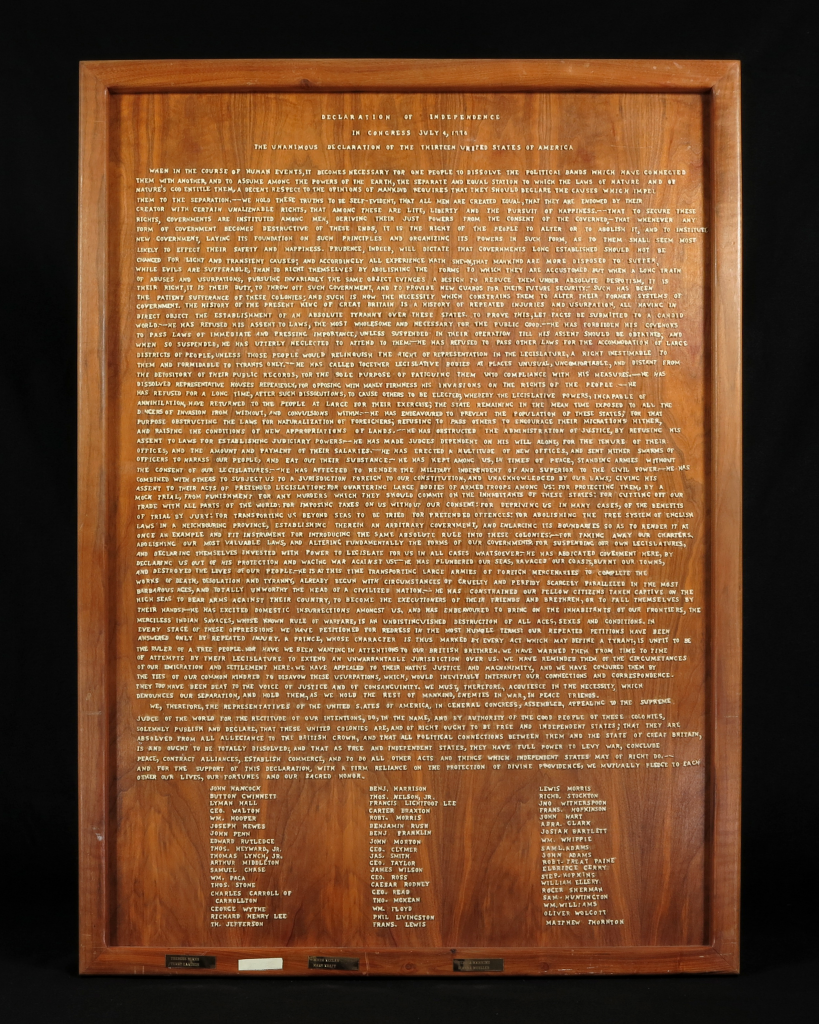
But it is the personal, often homemade, artifacts which illustrate ARBA’s and President Ford’s goals of how the Bicentennial would be commemorated by citizen participation. Unusual and unexpected handicraft items in the museum’s collection include a fanciful papier mâché statue of President Ford dressed as a Revolutionary-era Minute Man, presented to Ford in February 1976 during a campaign stop in Tampa, FL. One of the most popular and unique items in the collection is a four-foot-tall wooden plaque with the text of the Declaration of Independence spelled out in alphabet macaroni. A Wisconsin Girl Scout Troop spent 60 hours reproducing the Declaration using over 8,000 alphabet noodles, and the girls gave it to President Ford in October 1975.
Courtesy Gerald R. Ford Presidential Library & Museum
Accession No. 1981.9 a-d
Courtesy Gerald R. Ford Presidential Library & Museum
Accession No. 1981.63
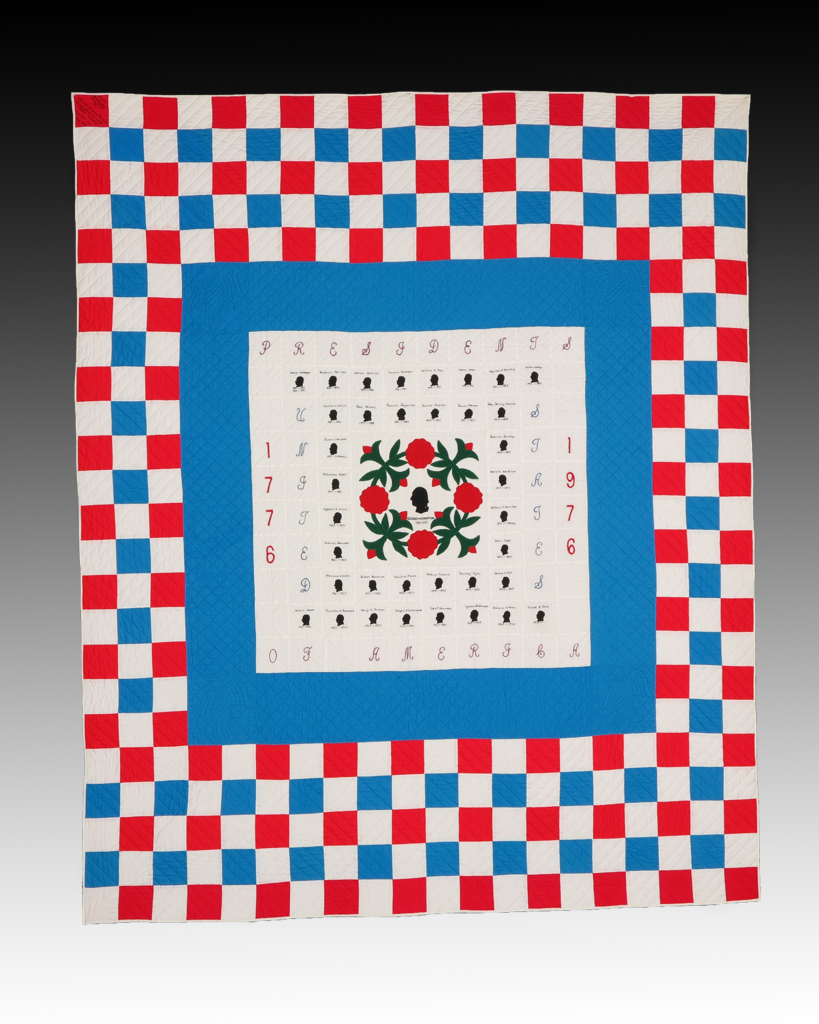
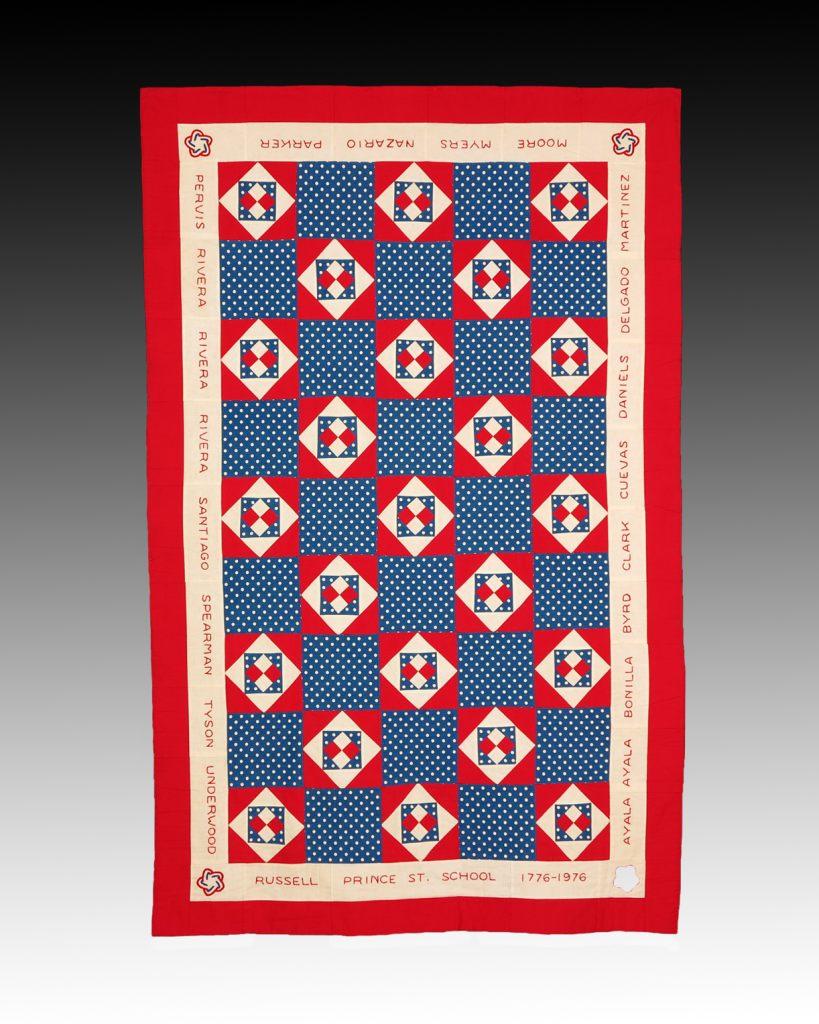
Many home crafters added bicentennial flair to their projects. Quilters—from elementary school students to retirees—used red, white, and blue fabric squares and honored historic patterns. For example, a quilt by Hazel B. Reed Farrell of West Virginia featured a red, white, and blue checkerboard border and silhouettes of American Presidents from Washington to Ford, with the former framed by a rose wreath in the center. The rose wreath is a classic quilt pattern made popular across the U.S. in the nineteenth century. It took Farell fifteen months to make this quilt by hand. In gifting this personal, labor intensive craft to President Ford, who accepted Bicentennial gifts on behalf of all citizens, she was able to participate in a nation-wide commemorative event.
Courtesy Gerald R. Ford Presidential Library & Museum
Accession No. 1982.1
Courtesy Gerald R. Ford Presidential Library & Museum
Accession No. 1984.106
Throughout the year of celebrations, President Ford wanted to ensure that the Bicentennial was for all Americans. In part because of the Bicentennial moment, in February 1976 President Ford issued a message first recognizing Black History Month, where he urged Americans to “seize the opportunity to honor the too-often neglected accomplishments of Black Americans in every area of endeavor throughout our history.” In October 1976, he signed a Proclamation recognizing Native American Awareness Week, stating, “No domestic matter had given me greater pride than my Administration’s record of turning about the discrimination and neglect that all Indians faced for so many years.”
Like many Americans, Ford recognized the nation’s 200th birthday as an opportunity to critically reflect on the country’s past two hundred years, consider who was being left out of the nation’s story, and think about how the nation could do better going forward. Despite the mixed feelings about the Bicentennial leading up to 1976, today the Bicentennial is remembered for the feelings of patriotism and nostalgia that the celebrations inspired. Even amidst the cynicism, there was a general feeling that the country was beginning to recover after a divisive period.
Perhaps most importantly, many Americans were genuinely interested in how the Bicentennial could be a moment not just to honor the past but help build a better future. Indeed, as President Ford reflected on the Bicentennial in his autobiography, “Rarely in the history of the world had so many people turned out so spontaneously to express the love they felt for their country. Not a single incident marred our festival. The nation’s wounds had healed. We had regained our pride and rediscovered our faith, and in doing so, we had laid the foundation for a future that had to be filled with hope.”
Authors: Dr. Mirelle Luecke and Dr. Richard Weld
What a pity the 250th birthday of our beloved United States is not led by a president like Gerald Ford. What, if any, patriotism has been inspired by the current leadership?